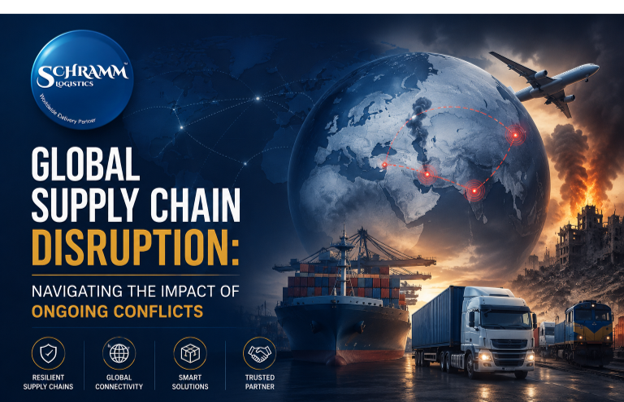
Global Supply Chain Disruption: Navigating the Impact of Ongoing Conflicts
Global Supply Chain Disruption: Navigating the Impact of Ongoing Conflicts
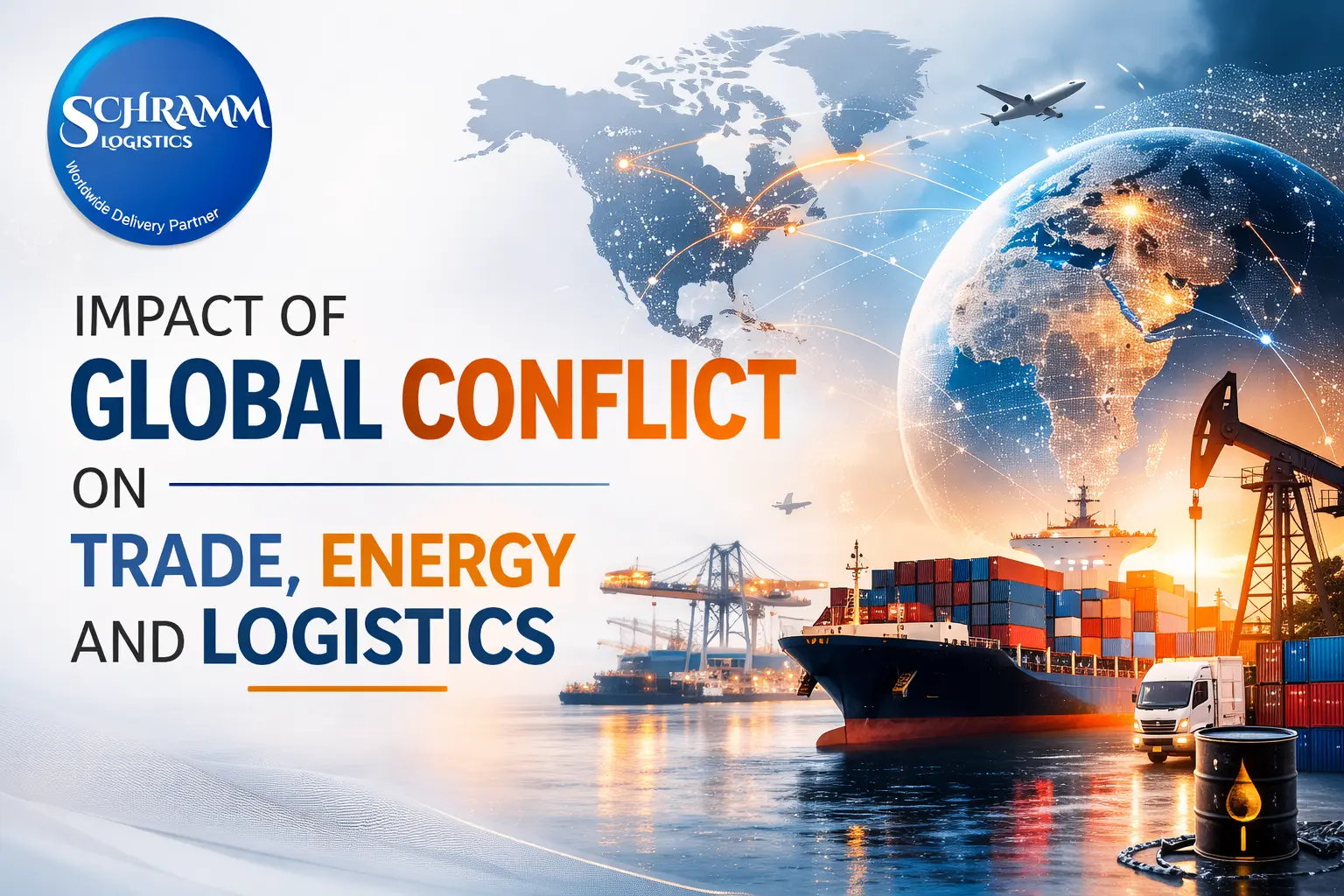
Geopolitical conflicts across key trade corridors have sent shockwaves through the global logistics network. From disruptions in the Gulf and Red Sea to shifting trade routes across continents, businesses are facing unprecedented supply chain challenges. Here is what is happening — and how Schramm Logistics is helping companies stay resilient.
The global supply chain has always been a complex ecosystem — a finely tuned network of shipping lanes, road freight corridors, air cargo routes, and customs channels that keeps the world's economy moving. However, in today's environment of escalating conflicts and geopolitical uncertainty, that network is under significant strain. Businesses worldwide are grappling with delays, rising freight costs, rerouting risks, and inventory shortages. At Schramm Logistics, we continuously monitor these developments and build proactive strategies that help our clients navigate uncertainty with confidence.
How Conflict Is Reshaping Global Trade Routes
Armed conflicts do not just create humanitarian crises — they disrupt the arteries of global commerce. Sanctions, closed airspace, blocked ports, and security concerns create ripple effects that impact businesses across every continent.
Europe
While the conflict in Eastern Europe continues to affect certain rail and road corridors, businesses have gradually adapted through alternative routes and diversified sourcing strategies. The impact remains significant but is increasingly being managed through network adjustments and improved supply chain planning.
USA
Transatlantic trade continues to experience disruptions as shipping schedules adjust to evolving geopolitical risks. Importers face challenges related to longer transit times, fluctuating freight costs, and reduced availability of certain commodities originating from conflict-affected regions. These factors are creating additional pressure on supply chains and manufacturing operations across North America.
Gulf Region – The Epicentre of Current Supply Chain Disruption
The Gulf and Red Sea region has emerged as the most critical pressure point in global trade. Ongoing security concerns and attacks on commercial vessels have forced major shipping lines to reroute cargo away from the Suez Canal and Red Sea corridor. As a result, vessels are sailing around the Cape of Good Hope, significantly increasing transit times, fuel consumption, insurance premiums, and overall logistics costs.
Since a substantial share of global container traffic traditionally passes through the Suez Canal, disruptions in this corridor directly impact trade flows between Asia, Europe, Africa, and the Americas. The Gulf region has therefore become the defining logistics challenge of the current geopolitical landscape, affecting businesses far beyond the Middle East.
The Downstream Effects on Businesses
These disruptions are not abstract concerns — they translate directly into real operational challenges for importers, exporters, and manufacturers:
- Longer lead times are forcing companies to hold larger inventory buffers, increasing working capital requirements.
- Freight rate volatility makes forecasting and budgeting more difficult.
- Congestion at alternative ports creates secondary bottlenecks.
- Production schedules are increasingly vulnerable to shortages of critical raw materials and components.
- Supply chain uncertainty impacts customer service levels and delivery commitments.
"In a disrupted market, the companies that thrive are not necessarily those with the most cargo — they are the ones with the most agile and resilient logistics strategies."
How Indian Ports Are Helping De-Risk Global Supply Chains
As global businesses seek alternatives to disrupted trade corridors, India is increasingly emerging as a strategic logistics hub. Major ports such as JNPT, Mundra, Chennai, and Vizhinjam are expanding capacity, improving turnaround times, and strengthening multimodal connectivity to support growing international trade.
India's geographic location provides a unique advantage. Positioned at the crossroads of major East-West shipping routes, the country serves as a natural gateway connecting Asia, the Gulf, Africa, and Europe. Continued investments in port modernization, dedicated freight corridors, logistics parks, and digital trade infrastructure are helping Indian ports become more resilient and globally competitive.
For companies looking to diversify routing options, reduce supply chain risk, and improve reliability, India offers a compelling alternative within an increasingly uncertain global trade environment.
The Schramm Logistics Solution
At Schramm Logistics, we have built our response around four core pillars designed to protect clients from supply chain disruption, regardless of where the next crisis emerges.
Dynamic Route Optimisation
Our operations team continuously monitors conflict zones, port congestion levels, carrier capacity, and market developments. We proactively identify alternative routes and transportation modes before disruptions become costly delays.
Multi-Modal & Multi-Origin Sourcing
Through our extensive network spanning ocean freight, air freight, road transportation, and rail logistics, we ensure that clients are never dependent on a single route, port, or carrier relationship.
Real-Time Visibility & Proactive Communication
Our advanced tracking systems provide complete shipment visibility while our logistics experts communicate potential issues before they escalate, enabling faster and more informed decision-making.
Compliance & Sanctions Navigation
Changing sanctions regimes and regulatory requirements create significant compliance challenges. Our dedicated specialists ensure shipments remain compliant with international trade regulations, reducing the risk of costly delays and penalties.
Why India Could Become the Future Hub of Global Sea Trade
The ongoing disruptions in traditional shipping corridors are accelerating a broader transformation in global trade patterns. As businesses rethink their supply chain strategies, India is uniquely positioned to become one of the world's leading logistics and maritime hubs.
Government initiatives such as PM Gati Shakti and Sagarmala, combined with significant investments in port infrastructure, coastal shipping, multimodal logistics, and manufacturing growth, are strengthening India's position in global trade networks.
India's strategic location near major sea routes, coupled with its expanding port capabilities and growing manufacturing ecosystem, provides the foundation for long-term supply chain resilience. As companies continue diversifying away from concentrated trade routes and single-source dependencies, India is expected to play an increasingly central role in facilitating global commerce.
The future of global logistics will be defined by resilience, flexibility, and connectivity. India is rapidly strengthening all three — making it a key partner in the next generation of global supply chains. Schramm Logistics helps businesses capitalize on these opportunities through integrated freight forwarding, customs clearance, warehousing, and supply chain solutions that connect India to the world.
Staying Ahead in an Uncertain World
Geopolitical instability is no longer a temporary disruption — it is becoming a permanent feature of global trade. Businesses that continue to rely on single-source suppliers and limited transportation routes face increasing risk. The solution is not to stop trading; it is to build smarter, more resilient supply chains.
At Schramm Logistics, we combine global expertise, local market knowledge, and proactive logistics planning to help our clients navigate uncertainty with confidence. Whether you need urgent rerouting assistance, a supply chain risk assessment, or a long-term logistics partner, our team is ready to help.
Ready to build a more resilient supply chain?
Speak to a Schramm Logistics expert today — no obligation, just solutions.
Schramm Logistics is not just your freight forwarder but it's your Worldwide Delivery Partner
श्रम लॉजिस्टिक्स "विश्वव्यापी वितरण साथी"